
The Good Neighbor

In 1933, President Franklin Delano Roosevelt announced that the United States would henceforth behave like a good neighbor in its dealings with Latin American nations. This was quite understandable, since FDR had decided to unleash a world war and needed to have a free hand to realize that project.
Mexico, Central America and the Caribbean all benefited from the decision made in Washington and for a few years could breathe a bit more freely. South America was still largely dominated by investments and policy decisions from London. In response, all independent republics followed US directives and after the US entry into World War II declared war on Germany and Japan. Because England needed it to remain neutral, only Argentina refused to follow US instructions until the war was almost over. On the whole, however, the respite was quite welcome all over Latin America.
For two decades, there were no direct US interventions in the area. In 1954 the US judged it necessary to put an end to a government in Guatemala that had embarked on a program of far reaching socioeconomic and political reforms. These jeopardized the extensive interests in Guatemala by the United Fruit Company (bananas!) and therefore a regime change operation was called for. After thus overthrowing the reformist regime of Jacobo Árbenz, the US notably honored Cuba (1960), the Dominican Republic (1965), Brazil (1964), Argentina (1966, 1976), Chile (1973), Panama (1989) and Haiti (1994) with regime change operations, recently adding Venezuela (2026) to the list (of these, only the Playa Girón or Bay of Pigs invasion in Cuba in 1960 being a dismal failure).
This was also the first ever direct US intervention in Venezuela. For more than a century since in 1908 Juan Vicente Gómez was put in the saddle thanks to Dutch armed intervention, Venezuela was allowed to run its own affairs without direct foreign interference. In 1899, Cipriano Castro was elected president, but since he refused to accept the dictates of foreign businessmen operating in Venezuela, he was in perennial conflict with those foreign capitalists. These were primarily engaged in the production and export of coffee and cocoa. In 1903 England, Germany and Italy dispatched warships for a blockade of Venezuela’s harbors. Briefly, Castro backed down but still persisted in his policies regarding foreign capitalists. Then in 1908 the Netherlands (to which Venezuela’s main foreign trading partner Curacao belonged) sent warships to blockade Venezuela, upon which Castro left the country, leaving control in the hands of Vice President Gómez, who then decided to cooperate with the foreigners.
Gómez, running the country himself, either as president or through others whom he used as a stand-in, presided over a fundamental transformation of the country. In 1914, after massive oil reserves were discovered around lake Maracaibo, Venezuela began to produce increasing quantities of oil. In 1928 it had already become the world’s second biggest producer (almost 16 million tons) after the US. It is important to note that most of that oil came from wells controlled by Standard Oil’s arch rival Shell, then directed by “the Napoleon of Oil,” Sir Henry Deterding. In those years, Venezuela had a population of only three million (1930).
Since most of Venezuela’s oil was being produced by Shell (which was about half English and had strong ties to the Rothschild Bank), Venezuela was off-limits for the US government, certainly until the 1940s.
After Gómez left the stage in 1935 for a time Venezuela reverted to traditional 19th-century-style politics, ending in 1950 with a traditional military coup led by a small group of colonels. One of these, Marcos Pérez Jiménez, became president in 1952, remaining in power until his ouster by another coup 1958. Since the leaders of the coup ordered a return to democracy, elections for a new president were held. The winner of these elections was Rómulo Betancourt, leader and founder of the social democratic AD (Acción Democrática) party. During the next four decades, Venezuela had a two party political system. The other party was the Christian Democratic COPEI (Comité de Organización Política Electoral Independiente).
The two-party system functioned quite satisfactorily, essentially because of Venezuela’s generous oil income. It is said that from 1945 to the 1980s, Venezuela earned more money than the aggregate amount of “Marshall Aid” handed out by the US to European nations. And that Marshall money was subject to stringent and limiting conditions.
Most Venezuelan oil was exported to nearby Curacao, where Shell operated a big refinery since 1918. In 1924, Standard Oil opened a refinery on the neighboring island Aruba.
In 1960, Venezuela was the world’s second biggest oil producer, with about 15% of total production. Since the population was only a little over seven million, Venezuela actually was a very rich country. By 1990, Venezuela had sunk to seventh position among the world’s crude oil producers, while the population had tripled to about 20 million. In other words, in a relative sense, oil income was shrinking. However, since the domestic market was too small to seriously consider industrialization, and income still relatively high in comparison with other Latin American nations, the stability of the political system became affected. As a matter of fact, it was built on massive corruption and graft. Some sort of change was therefore becoming increasingly inevitable.
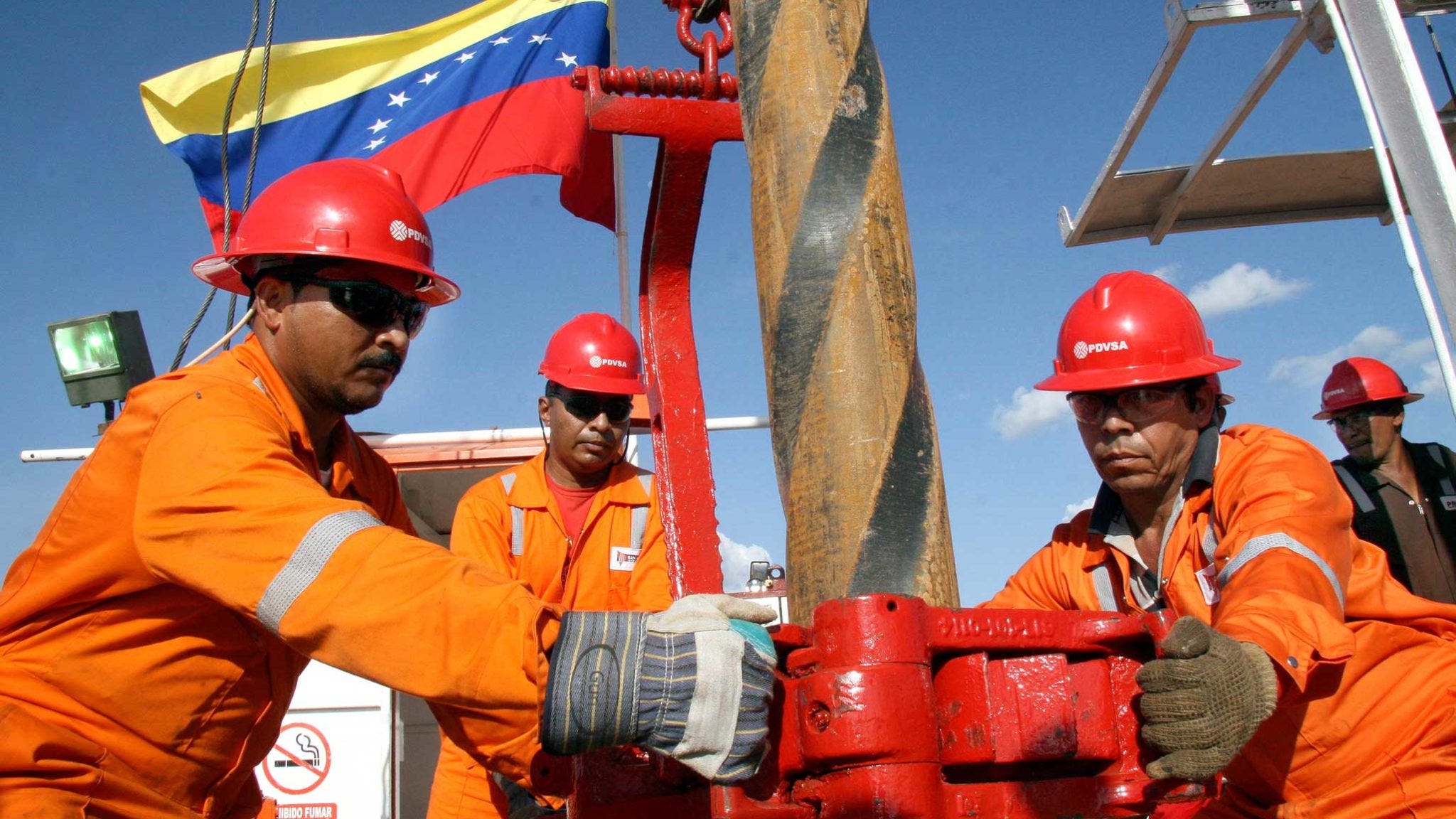
Change came in the 1990s, in the person of Hugo Chávez, a popular army officer. In 1992, wishing to realize a great number of urgently needed reforms in the country, Lt. Col. Chávez staged a coup against president Carlos Andrés Pérez. Popularly known as “CAP,” this womanizing veteran leader of the AD party was widely known for being corrupt to the core. During his first presidency (1974-1979), he stole millions out of the national oil income and invested these in building projects in Miami. He was elected for a second term in 1989, because voters believed he had already stuffed his pockets sufficiently to refrain from another round of stealing. Yet from the outset of his second presidency, CAP began to steal on an even larger scale. Small wonder that Chávez enjoyed massive popularity. Although he was arrested, tried and thrown in jail for his coup attempt, he got out in 1994 and solidified his position as a leading figure in national politics outside the two-party system.
In 1999, Chávez was elected president, and stayed in power until 2013, when he died from a mysterious disease. The new leader was Nicolás Maduro, a political ally of Chavez, who continued the policies of his predecessor to the dismay of the Americans.
Since Chávez sought to free his country from the clutches of the Good Neighbor, he soon became the target of American anger and indignation. What the Americans above all failed to understand was that Venezuelans were seeking a way to become a truly independent nation in their own right, fully in line with the dreams and prospects of national Liberator Simón Bolívar.
After some two centuries of efforts, it seemed the time had finally come to realize the old dream. However, no matter how you try to change your living arrangements, there is one thing you cannot do, and that is choose your neighbor. With a neighbor like the United States, it is by definition impossible for a nation to be truly independent, especially if it has coveted natural resources such as oil.
Today, apart from direct neighbors such as Mexico and Cuba, the US also has indirect neighbors like Venezuela where it wants to impose its controls. Just like the Mexicans and the Cubans, the Venezuelans have no option but to conclude that they are far from God and close to the United States.
Your historical analysis of US-Latin American relations through the lens of Roosevelt's "Good Neighbor Policy" provides crucial context for understanding contemporary hemispheric politics. The irony you highlight—that a policy initially designed to reduce interventionism gradually became cover for sustained economic and political dominance—reveals how diplomatic rhetoric often masks continuity in power structures. Your account of Venezuela's trajectory from Chávez's democratic socialist experiment to current international isolation demonstrates how resource nationalism inevitably draws imperial attention. The comparison between direct neighbors like Mexico and Cuba versus "indirect neighbors" like Iran and Russia is particularly insightful, showing how US foreign policy constructs proximity through ideological rather than purely geographical terms. This framing helps explain why some distant nations receive more interventionist focus than actual border states.